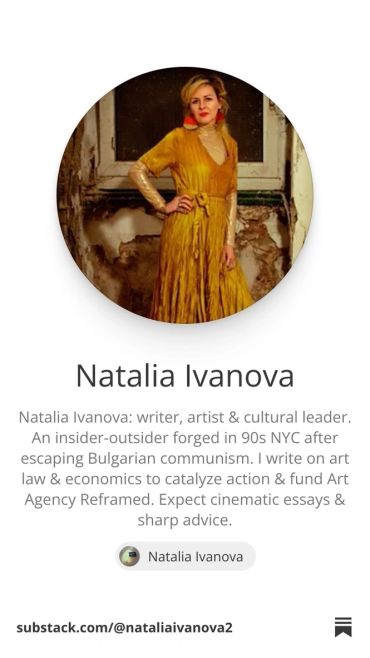
Natalia Ivanova (born Natalia Latchezarova Ivanova in Burgas, Bulgaria, March 25, 1975) is a curator, cultural strategist, criminologist, and writer whose practice examines the intersections of art, law, and political economy.
Ivanova's artistic expressions are grounded in reframing patterns and hierarchies across fields, mediums, and genres, through long-form collaboration with the art collective Dadais Americanus, which she co-founded in 2020 while living and working in Oakland, California. Her contributions to the collective span visual art, text, and time-based media, with a sustained focus on creating heterotopic openings within the system : ones that operate beyond the conventional logic of the capitalist-driven market, and beyond the ever-expanding field of art itself.
As Executive Director of Pro Arts Gallery in Oakland (2014–2024), Natalia transformed one of the Bay Area's oldest avant-garde institutions into a living commons: a decentralized, cooperative cultural formation that served both as an arm of the nonprofit and as a pilot for a small-scale art market model rooted in shared governance and collective ownership. During the pandemic, she mobilized critical funding in direct support of artists, marginalized art spaces, and underserved creative communities in Oakland , also securing resources that Pro Arts redistributed to individual artists, collectives, and grassroots organizations through a range of programs, initiatives, and regranting mechanisms. Simultaneously, she launched three new artist-centered, community-rooted projects: the Pro Arts Music & Production Studio, the Social Impact Projects Incubator, and the Teaching Institute for Art & Law — each conceived to place marginalized artists and creatives at the center of a resilient and equitable future art economy.
As Executive Director of Redhouse Arts Center in Syracuse (2006–2010), Natalia conceived and launched Redhouse Art Radio — the region's first 24-hour art and culture internet radio station. This was a venture recognized for its innovation with the prestigious Kauffman Entrepreneurship Award. During her tenure, she also secured capital funding for a new state-of-the-art facility to establish an international artist residency program in the heart of downtown Syracuse, hosting month-long residencies for theatre and performing arts practitioners.
Long before the internet became infrastructure, Natalia was already building inside it. In 2001, she founded Flux Digital Art Space as both platform and provocation: a living network conceived to confront not only the digital divide but what she had already identified as its inevitable shadow: the creative divide. In parallel, she was reshaping who gets to be called a creator, developing some of New York City's earliest afterschool curricula at the intersection of digital art and professional practice. In doing so, she opened doors into creative professional life that had long been sealed by assumption, expanding the field, redistributing its possibilities, and quietly but persistently redrawing the boundaries of who belongs inside it.
Her major curatorial projects include The New Situationists (2018), the first survey of disruptive art practices in the San Francisco Bay Area, which was a landmark exhibition that brought together artists, activists, and cultural agitators working in the tradition of radical situationist thought, mapping the living edge of resistance art and culture in the region. The Post-Capitalism Festival (2018) was a multidisciplinary public event gathering artists, economists, organizers, and thinkers to collectively imagine and embody cultural and economic life beyond capitalism: part festival, part forum, part provocation. These anchor projects were accompanied by a wider constellation of exhibitions, public programs, and collaborative experiments conceived alongside protest artists, independent cultural workers, and grassroots organizers, with each project refusing the clean separation of art from struggle.
As a writer, Natalia produces essays, critical texts, and long-form research that excavate the mutual constitution of artistic and legal systems, mapping the often-invisible mechanisms that structure cultural value, tracing alternative economies, analyzing modes of artistic governance, and foregrounding practices that resist the extractive logics of institutional capture. Her writing functions simultaneously as conceptual infrastructure and speculative architecture for the new cultural systems she builds elsewhere. She is the author of Reframing the Value of Art and Fair Labor in the Context of a Sharing Economy and co-author, with Marc Herbst, of The Commons: Of Friends and Lovers. These texts circulate today less like publications and more like tools, finding their way into the hands of those working at the edges of cultural justice, platform cooperativism, and artist self-determination.
Natalia's international practice extends these commitments across geographies: a 2023–2024 curatorial fellowship in Berlin drew her into the city's experimental and political art communities, catalyzing ongoing collaborations that continue to bridge Berlin and U.S. cultural ecosystems.
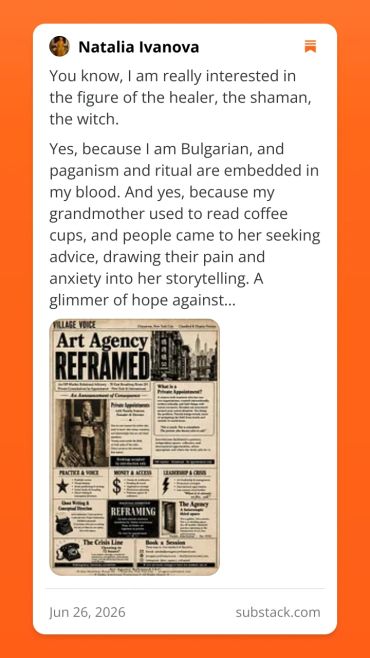
Natalia is currently based in New York City, where she has opened her own heterotopia in the heart of Chinatown. Art Agency Reframed is her long-term obsession: a heterotopic space conceived as an off-market market, one that simultaneously transgresses and reimagines the structures through which cultural work is labored, produced, exhibited, and sustained. Through the Agency, she consults and produces across a broad range of engagements and art fields, working directly with individual artists, spaces, partners, funders, and international collectives, while also navigating the art market itself, dealing in both primary and secondary market, because the rent, as ever, must be paid.
We use cookies to analyze website traffic and optimize your website experience. By accepting our use of cookies, your data will be aggregated with all other user data.